Monday, 15 September 2008

Voodoo Donuts - The Magic's in the hole..!


Let me tell you what I love about America. America has some really crazy and funky people. I have seen things there that I've never seen anywhere else in the world, and just left me shaking my head in disbelief, because peoples innovation and creativity seems to be boundless... a good example of this has to be Voodoo Donuts...

Take a simple confection like a donut...In SA the most folks would do with a donut is coat it in chocolate icing and sprinkle 100's and 1000's over or coat it it cinnamon and sugar. Here in Germany they are filled with strawberry jam...but in Portland Oregan...not a chance will you find such boring stuff...

Sunday nights DMAX screens Anthony Bordain's foodie proramme, which let me tell you, is always a scream to watch. I don't know if you poor folks in the Heart of Darkness get to see it, but if not...WHAT A PITY...anyway, this last Sunday's show Bordain was in and around Portland Oregon, and it seems like a pretty neat place if you ask me. But the best thing about the city just has to be Voodoo Donuts! No lies...it sounds pretty creepy for a donut shop, but it is really a wild place. They have got a donut menue to blow your socks off. Check this out...


-Grape Ape(raised doughnut with vanilla frosting and grape powder

- Dirt(raised doughnut covered with vanilla glaze and oreo cookies)

- Arnold Palmer(cake doughnut covered with lemon and tea powder)

- Butter Fingering(Devils food, vanilla, and crushed Butterfinger)


- Neapolitan (chocoalte doughnut with vanilla frosting and strawberry quick powder)

- Triple Chocolate Penetration(chocolate doughnut, chocolate glaze, and cocoa-puffs)

- Voodoo Doughnut(voodoo doll doughnut coated in chocolate filled with red jelly...when you bite it it bleeds!)

- Dirty Snowball(chocolate cake doughnut covered with pink marshmallow glaze and surprise filling..???...Hmmm....might be fill qualudes!)

- Apple Fritter(apple/glaze/doughnut as big as your head)

- The Memphis Mafia(chocolate chips/banana/ peanutbutter/glaze big!)

- Portland Creme(raised doughnut filled with creme and covered in chocolate with two eyes)


- Cock-n-Balls(Bachlorette party favorite, tripple cream filled, with your favorite saying written right on it. Comes in its own pink box. $4.95 Order ahead as supplies can be limited... I bet!)

- Nyquil Glazed and pepto-bismol (currently on hold)

- No NameA doughnut so good we couldn't come up with a better name. It has chocolate rice crispys and peanutbutter on it.

VEGAN(thats right, vegan doughnuts! assorted flavors, come in and eat many)

Not only is Voodoo Donuts Portland Oregon's home of the Pepto Bismol doughnut. Pepto-Bismol. by the wayside, is an over-the-counter drug produced by the Procter and Gamble company used to treat minor digestive system upset and is aparrently bright pink....but they also used to make a donut called a Speedball...yip...as in speed! That is cough mixture and caffien donut...but they had to take that off the menu, too many late night ravers were raving on Speedballs, so the F&D police told them they were not allowed to combine medicine with food...The Pepto Bismol is also on hold despite the fact that one would probably need it after noshing down a half dozen of these baby's.

But being inspired by the idea of custom donuts, I thought I would create a few of my own for all my mates...so here goes...

Moonie Donut - Triple Death by choclate. Chocolate donute with choc chips, filled with chocolate syrup, coated with a dark choclate glaze and covered in smarties...(they lady is expecting...have a heart.!)

Gerrie Donut - Make that a Black Lable donut toped with a green Jägermeister glaze

Jaynie Donut - The woman is homesick...so a mielie pap donut topped with a tomatoe and onion sauce with a chunk of Boerewors on top, should chase away all the homesickness and bring on some other 'sickness' which might be fixed if she pops a Pepto Bismol donut afterwards...

The Jolly Jack Donut - A vanilla donut with a half a bankie of Durban Poison, glazed with a lime glaze and sprinkled with peanuts, served with a 2L Coke and 5 packets of Simba chips for the munchies.....

The MfG Donut - Keeping things traditoinally Germanic, make that a plain donut with saurkraut and schinken topped with a brattwürst and rounded off with a Löwensenf glaze, comes with a 6 pack of Krombacher Weitzen's...

The Jenny Donut - Plain donut no frills...just a Malborough on the side..

Lee Donut - Vanilla donut with guava and custard filling, sprinkled with choc chip cookie crumble..


Tuesday, 2 September 2008

The Stroy of Krishna and Radha


When I was a little girl and it came to dress up time, I never wanted your run of the mill fancy dress outfit...oh no! My Ouma had to dig into her fabric collection to drape me in meters of silk and chiffon to make me a sari!
Yip...it's a fact, ask Oupa. I wore a sari and put a red dot on my forehead with Ouma's lipstick long before I even started school. Don't ask me where I got those ideas about being an Indian girl, but to this day I have a love and fascination with India, the people and their history, and I admire and enjoy Indian art, architecture, miniature paintings, sitar music, Madras curries and the Karma Sutra...and that all loooong before it was made fashionable by Bollywood!


Which brings me to the topic of this post...I have never been into Hindu belief at all, don't get the wrong impression by this post! I was brought up in a Christian home, where any curiosity in such heathen belief was seriously frowned upon...and of course, it is all quite complicated and so, I suppose, like most other Christians, I was never really bothered with it in case it brought bad vibes, if you know what I mean.....But once I did read a bit about Hindu mythology and belief, I found it is very beautiful, and most interesting! There are many parallels to more familiar stories, and the perfection of the paradise setting...so much like Adam and Eve in the Garden of Eden, and I could go into it deeper and point it all out and give you my wise opinion on it all, but time and space here does not allow for that today...but oh..THE ART..I LOVE the art!...and it is the art that tweaked my interest in the stories behind the paintings and sculptures in the first place...

By now regular readers to this blog will have figured out that I have a bit of a thing for Kitsch, and so, of course, I have a wonderful collection of garish Hindu paintings that my family cringe to look at...but being the Queen of this blog, I will force you to appreciate the beauty and romanticism of Hindu art by introducing it slowly, with the love story of Krishna and Radha.


The Radha-Krishna amour is a love legend of all times. It's indeed hard to miss the many legends and paintings illustrating Krishna's love affairs, of which the Radha-Krishna affair is the most memorable. Krishna's relationship with Radha, his favorite among the 'gopis', has served as a model for male and female love in a variety of art forms, and since the sixteenth century appears prominently as a motif in North Indian paintings. The allegorical love of Radha has found expression in some great Bengali poetical works of Govinda Das, Chaitanya Mahaprabhu, and Jayadeva the author of Geet Govinda.

To cut a long and involved story short, as you should know, Hindu's believe in reincarnation, and so the Lord Krishna was the reincarnation of the Lord Vishnu. (I told you it's complicated!), but for now lets stick with one life time at a time....


So who was Radha you might well ask?
Well, Radha was one of the gopis in the Vrindavan village...and gopi is a word from Sanskrit (गोपी) meaning 'cow-herd girl'. So Rada was a cow herd girl from Vridavan, and also the reincarnation of the Goddess Lakshmi. Different 'sects' of Hindus believe different things about the deities and gods, some believe Radhar is a higher diety than Krishna and vice versa...but anyway...that's why it's complicated..


Just as Lord Vishnu was born as Krishna, Goddess Lakshmi was born as Radha! And so the story goes that Lord Krishna and Srimati Radha were each other’s best friend from childhood, and who grew up together. I must point out that Krishna was a married man, who had quite a few wives, who were also very jealous of Radhar! But for some odd reason he never married Radha. Then as I said, other Hindus believe she was his wife. In a number of versions of her story, although Radha's first love is Krishna, she is later forced to marry Abhimanyu, the son of Jatila. One source for this information is Sri Sri Camatkara Candrika by Srila Visvanatha Cakravarti Thakura. Other traditions give the name of the husband of Radha as 'Chandrasena'. Be that as it may, Krishna and Radha spent all their time in each other’s company, and they loved each other very much, so it seems odd that he didn't just marry her. So maybe all along they were these desperate lovers who couldn't have each other, Hinduism does confuse the matter somewhat..


Well.. taking a look at the art work featuring these two 'best friends' I can tell you without a doubt, Radha was absolutely smitten with Krishna! So if it wasn't that she was forced into an arranged marraige that she hated, then what's the story?
No ways does a woman look at a man like that when they are just 'friends'! But Krishna, *sigh*, typical male, thinking like men do, probably realized that to marry her would just spoil everything....and he was probably right too...I mean look at how marriages start off...and how they end up...oh hell..yeah.


And how did Krishna and Radha show their love for each other? (NO..not like that...!)
They wore each other’s colour and tried to be like the other person...(hmm..yeah ..right)

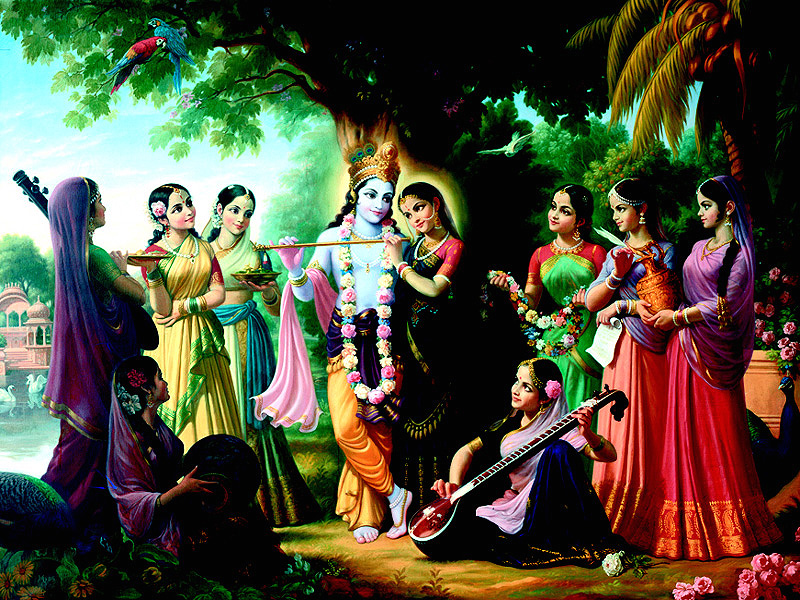
Okay, let me explain. As Krishna was as beautiful as the moon and his skin was blue as a cloud and softer than a blue lotus , Radha would always wear a blue sari and bedeck herself with blue sapphires. And because Radha’s skin was golden in colour like a flash of brilliant lightning, Krishna would always wear a yellow or golden dhoti. Radha wore tinkling anklets or payals on her ankles, and so Krishna wore them too. When they walked together it made a beautiful sound ...all far too romantic for just platonic friendship in my humble opinion! I mean just take a look at the pic below of them in different scenes together...


Krishna wore a peacock feather on his head, which shimmered and caught the light resembling a bright and beautiful rainbow, and a garland of pearls (moti). The pearl necklace that hung on his chest looked like a row of swans flying across a blue cloud. Krishna also wore a garland of colourful wild flowers called the Vaijantimala. Their bodies would shine with an unusual glow, and while Krishna shone and sparkled like the soft silvery moon, Radha seemed to dazzle like golden lightning.
Krishna also wore fish-shaped earrings and carried a flute. So when Krishna played his flute, Radha knew Krishna was in Madhuvana and she would go running to him.


All the cows, calves, deer and birds would stop on their tracks and listen enchanted by the divine music of Krishna’s flute. Krishna would hold the cow by its chin and Radha would pat its head. The swan would come waddling from the Yamuna and gather around them. The deer would rub its soft nose against Krishna’s feet and nuzzle. The birds would perch on the tree listening to the music of the flute. Sometimes when Krishna waited for Radha to join him, he would spend time talking to his animal friends in the solitude of the groves.

And a the story goes on , that the day would melt into evening, blue clouds and the moon would be up on the sky and Radha's eyes would be fixed on Krishna, and Krishna’s on Radha. Krishna was as beautiful as a moon and his skin was as blue as the heavens. Seeing the moon and evening sky, Radha would be full of love for Krishna. Krishna was her life and soul—the treasure of her life and the very life of her own life. Radha adored Krishna with all her heart, all she wanted to do was to make Krishna happy—and making him happy was what made her happy. She found joy in his joy. She did everything in her power to please him even if it meant putting Krishna and his wishes before herself and hers, asking for nothing in return. Hmmm...does seem a bit naive. Is that what true love is all about...ahh...don't you just wish!
And what about Krishna? What were his feelings for Radha? Let’s see what Krishna had to say about this himself…..

"The whole world finds true happiness when they are in my company, but what about me?I feel true happiness only when I am with Radha.
Everybody says that I am more beautiful than anything they have ever seen and that they feel joy in their heart when they just look at me. But my eyes find pleasure only when they rest on Radha.
The soft melody of my flute attracts everybody and everything to it, but my ears are enchanted by the sweet words of Radha alone.
Although my touch is cooler than coolness of many moons put together, I am refreshed only by the soft soothing touch of Radha.
I am the life and soul of the whole world but my life and soul is Radha, and Radha alone."
Oh my goodness...no wonder Radha was crazy for him! Such is the love of Radha and Krishna...*sigh*.. how do we put that back into our lives in this day and age of cold, harsh reality? Gosh..we can only try!

Tuesday, 19 August 2008

The Season of the Witch


'Hocus pocus, tontus talontus, vade celeriter jubeo'

Some folks may have heard about the witches of the Brocken, who on Walpurgisnacht, mount their broomsticks, pet dogs, goats or husbands and fly out into the dead of night to a plateau on the Brocken Mountain deep in the dark forests of the Harz Mountains. Here a huge bonfire rages through the night, and on this plateau, known as the Hexentanzplatz, the witches await the arrival of their master, the Devil.

Well so the old folk lore goes anyway. On the 1st of May, postcards, beer steins, and wooden carvings glorify the season of the witch. Little old ladies cheerfully pressure shoppers into pointy black hats, tarot cards, and devilish horns that glow in the dark. But back in ancient pre Christian times, it was all a bit more involved than just the tourist attraction it has morphed into, where visitors today dance the night away and scream at the spirits of winter. Today May 1st draws crowds to the tiny village of Schierke, and the towns folk do a roaring trade a la Harry Potter. But do real witches gather on the crowded Brocken on Walpurgisnacht...?


Oh, I have no doubt that the Wiccans and New Agers flock there in droves to have a get together, just as the modern 'druids' congregate at Stonehenge. But reality is less exciting nowadays to what it was in the very far distant past, where the real 'magic' took place!

As a spring festival, May Eve was originally dedicated to Walpurga, a fertility goddess of woods and springs, who, as legend would have it, rewarded human helpers with gifts of gold. And, just like Holda, Walpurga is also associated with spindles and thread (the hand tools of women for weaving). These commonplace items took on a magical significance on May Eve, when they were used for divination and love spells. In E.L. Rochholz's 1870 folklore study, he describes Walpurga as a white lady with flowing hair, wearing a crown and fiery shoes. She carries a spindle and a three-cornered mirror that foretells the future. In the layer cake of northern European mythology, the symbols strongly suggest connection to the Three Norns, or Fates. These demigoddesses spun and wove the web of life, casting prophecies into their triangular Well of Wyrd, which watered the tree of life.

The truth is, it is based on very ancient fertility rites that have been Christianize and watered down to nothing. Under Christian influence, Walpurga's rite of spring was transformed into a day to drive out the forces of pagan darkness, rather than the darkness of winter. A Saint Walburga, now remembered on May 1, emerged in the eighth century to battle with the old goddess. As it did with the Celtic fire goddess Brigi. The medieval church often elevated the elder deities to sainthood in its attempts to suppress paganism and stifle older rituals....but why?

Things have changed a lot from those long ago times and few people today understand anything about its original meaning! Life is not a struggle anymore, where people are personally, and absolutely dependent on the earth and the land for their survival. For the Celts and the Teutons, the coming of Spring was a very important time. They celebrated the earths awakening from it's winter sleep, and again to new life which provides food for the people. The earth was prepared for the sowing of the crop, they wanted a long sunny summer season to ripen their grain and the fruits in the orchards, fatten their pigs and bring new life forth from there flocks and herds...And most important to the cycle of life, young maidens were prepared for the 'sowing of a crop' so to speak, and they took husbands! Married women had to bring forth the next generation, because not only did bad crops over the summer season mean hardships and possibly even death over the winter, more importantly, a family without strong young sons and daughters to help plough the fields and tend the crops was pretty much in for a lean and not so prosperous time...and a woman alone without a man and family was dead on her feet!


..and herein lies the secret of the witches...Why did mainly women go to these celebrations? Why are there rumors of wild sex orgy's on witches sabbath? What's with the old crone image?...Stories don't just spring up out of nothing..It all had little to do with hocus pocus...and more to do with just pocus!

According to Hans Baldung Grien (ca 1484-1545) and Pierre de Rostegny, aka De Lancre (1553-1631), (who were writing about these pagan rites during the Christian period remember), human flesh was eaten during Sabbaths, preferably children, and also human bones stewed in a special way. It was also said by some authors that salt, bread and oil were prohibited because the Devil hated them, while other testimonies told about delicious dishes. Other descriptions add that human fat, especially of non-baptized children, was used to make a magic potion that enabled the witches to fly. It was also believed that witches could fly by themselves, ride a broom, or be carried by demons to the place of the meeting.


The most common belief on which authors agreed is that Satan was present at the Sabbath, often as a goat (poor beastie!) or satyr, and many agreed that more creepy demons were present. Another belief said that sometimes a person could offer his/her own body to be possessed by some demon serving as a medium. It was believed that the Sabbath commenced at midnight and ended at dawn, beginning with a procession, continuing with a banquet, then a Black Mass, and culminating with an orgy in which non-marital or sexual intercourse with demons in male or female form was practiced. Consumption of hallucinogens and sometimes alcohol was often reported.


Horrific stuff hey...would you go into the Black Forest at night after being told that such a goat god was in there with a covern of witches? Well, there are some grains of truth in there, but please note...I said GRAINS... nothing like the horror portrayed! It was no wonder the populace wanted to see these dreadful witches burned at the stake...But forget not, that most of the recounting of such goings on at witches sabbath were obtained under great torture and all dating to Christian times, so all thanks goes to the dominant Christian Catholic church for a lot of this this, which viewed those old pagan religions with alarm.


The real truth is not nearly as dramatic, but never the less interesting, and pretty raunchy stuff...! The claimed dates of the main Sabbaths seem to correspond to those of the most important pre-Christian heathen festivals, and Scandinavians, Anglo-Saxons and Druids practiced these rites in the forests and mountains of Europe. This is how it really went.


In a time when raising a family was the main purpose of life, women who were having a battle to fall pregnant, or miscarried, or were considered barren, would consult the old mid wives, who held a very import station in society back in those times. They were the Deliverers of life and there role was considered magical and something of a mystery to the menfolk! As women gave birth, they sought and received care from supportive others. At an unknown point in the cultural evolution, some experienced women became designated as the 'wise women' to be in attendance at birth. Thus, the profession of midwifery began. Indeed, as historians have noted, midwifery has been characterized as a social role throughout recorded history, regardless of culture or time.


They were the ones women turned to, to consult to find solutions to the female problems, and as I have stated above, everything depended on the cycle of birth and life, the family and children that bound man and woman together. Giving birth was the successful end and beginning of a new life, but failure to fall pregnant in the first place was a catastrophe that could see a wife discarded by her man for a woman who was able to produce healthy babies. This could subject the unfortunate first wife to a life of poverty and starvation! Never did it occur to menfolk that maybe they were shooting blanks, and who was going to point fingers at the man?

So the old crones would be consulted by desperate women, and so would start the secret events of the 'wise ones', who would secretly find strong, robust and healthy young men who they drew into their plans, men who were willing to play an anonnymous, honorable and important role... of sperm donor..!
In the dead of night the women would gather in the secret places of the dark forests, surrounded by tales of demons and devils, and these young bucks who the old crones managed to procure, would don masks, and yes...masks of beasts with horns and antlers, which are symbolic, and a male symbol of virility. They became Cernunnos 'The Horned God'. They masked themselves so that no woman could identify who they were, as they were merely playing a role of service to these women, and any progeny spawned of Walpurgisnacht would be the product of 'magic', and go on to be raised as the children of other men...and so these strapping young men with raging horns would go about copulating with the lusty maidens of the village desperate for their sperm!


The old women would prepare a feast, giving the men and women potions of mead and wine to keep their nerves steady and relax them. Teas, soups and stews of magic mushrooms and other herbs and plants which served to make the experience seem surreal and other worldly...I suppose much the same as one would do today when you're planning on seducing someone and need to make it easier!


This was never about porn and lust, it was about procreation, the real 'magic' in it all being the spark of life and later new birth of a perfect human baby! But it all had to be kept secret to protect those involved, the old 'wise ones' who made a living out of 'matchmaking' and 'birthing', the stud men who were having sex with other mens wives, the women who were having sex with strange masked men, and the children that were born as a result of those nights...and so too was born the horror stories of witches, demons and devils. First the myth of demons and devils was created to scare any prying and peeping eyes that might wander into the dark forests to spy on the proceedings of the 'witches' and 'gods', and later out of speculation derived from the recounting of what spies who had braved the darkness and the unknown had seen... strange and bizarre things, unspeakable acts, moaning and screaming in the firelight!
Of course these tales grew tails, and especially during the Christian era where sex was burdened with hang-up's, considered something shameful and not even to be mentioned by married people, a fertile breeding ground for all sorts of wondrous beliefs about the charms and spells of witches and the occult sprang up!


Progressing on into modern times, we have a revival of interest in ancient mysticism, the occult and whatever grabs the imagination, all the doings of the Inquisition are poo pooed and looked upon with warranted horror...but now, as far as belief is concerned, anything goes, and all has again been corrupted to lead people to renewed belief in the super natural powers of a witch! There are people today going though all sorts of ritual knowing very little about it, in a belief that they will gain something tangible out of it all. Truth be told, "Modern Witchcraft", commonly called "Wicca", is the iron tit of bullshit that has so many Western women today 'spellbound'. It was started in England with an English civil servant, amateur anthropologist, writer, and occultist by the name of Gerald Gardener. Gardener set up his following only as early as 1949, with the publication of his "High Magic's Aid", and "Witchcraft Today", where he blends the old "Mother Goddess Religion" with the teachings of Margaret Maori, "The witchcraft in Eastern Europe", and "The God of the Witches" (1933), borrowing practices from his friend, the freak, British 'Satanist' Aleister Crowley, and ideas from Hinduism, Theosophy, Freemasonry and Rosicrucians...


In America, it was revived by Rosemary and Raymond Buckland and Sybil Leek in the 1960s who took it one step higher, thereby creating a vast source of inspiration with great packaging and marketing in the movies and on TV. This has grown into a huge industry that has aided in the popularity of witchcraft, which in turn has seen Neo Paganism officially recognized as a religion by the IRS, with tax exemption to the Church and School of Wicca! Talk about a great business plan!!


The truth is no longer something out of this world, the unknown meant to scare. When one considers that what happens beneath the sheets between almost every man and woman, it leaves one aghast that the unknown facts have been the spawn of tales of horror and magic that have lasted over the passage of time!

Monday, 11 August 2008

Fancourt revisited


Howdy folks..now this post might not interest many of you, but I am putting it up mainly for Oupa, as it will blast him back to another time ..

I came across THIS STORY about old ex SA cricketer Garth Le Roux, remember him, well anyway, turns out that since he no longer swings a bat, he is into the real estate business, and did some deal that got the Receiver of Revenue on his arse...but what got me going was that the property deal he is being schneid for involved my old home..FANCOURT!


Ja Oups...can you believe it hey...never a dull moment with that property!......I am a very, very lucky gurlie, because I have have had some experiences in my life that most people would never have in two lives, and I count my time at Fancourt as one of the most pleasant and beautiful highlights. Yes, it really was my home once upon a time when I was a princess. Moonie, if you ever wondered where I was after I left Springs...I was at Fancourt! I used to live there in the gate keepers lodge many years ago, when the estate was still private property, and a most magnificent old English style country seat.


At the time that I lived there, it belonged to Andrè and Helena Pieterse, and Andrè tried very hard to farm it and make it a viable enterprise. Sadly it would seem he ended up in the manure business, and lost the property in the old end...or maybe he was just clever and decided to cut his losses, and split out of SA when it turned into Mandelatopia...who knows..

Be that as it may, I will tell you something...forget about the prestige and what all of owning a possie at Fancourt today, those yuppies know nothing!..When I lived there, it was my private domain, a most beautiful farm... Now it's just another commercial enterprise to attract rich neaveau riche and a whole conglomeration of snob neighbours who like to play golf all day...not like when I was there, swiging out of the apple trees, riding our horses like maniacs through the lucern fields, or trying to catch piglets in the paddocks... I know Hansie Cronje had a house there before he died, so did other South African celebrities. But I had the privilege of living there when it was a little piece of English country side and old world life at the foot of the Outies.


THE history of Fancourt is littered with the financial heartbreak and tragedy of former owners, and can be traced back over 150 years.

Henry Fancourt White built a country house in Blanco, at the foot of the Outeniqua Mountains for his homesick English wife, in the early days of South Africa's expansion. The days of ox-wagons, pioneers and impassable mountain ranges.
The building of Blanco House, as it was named at the time, was in the style of a Cotswold Mansion, and proceeded slowly from 1859. The entire estate was modelled on that of English farms of the time, with fields divided up with stone walls and hedges, the gardens around the house were a mass of rose gardens and lily ponds, trees and creepers to remind Henry's wife of her homeland England. The dusty tracks and farm roads were lined with hedges that were so tall you couldn't see over them even if you were on horse back. Henry, a wealthy man at the time, suffered a major financial setback in 1860 and died soon after at the age of 55. Blanco House was put up for auction in 1857: "a thatched-roof double-storey building with ten airy rooms, kitchen, pantry, outbuildings and servants' rooms". Well, I remember the out buildings were beautiful stables and a tack room full of riding equipment, saddles and bridles etc, there were paddocks and stalls for cattle and calves, a dairy and pig sty's. Ducks on the lily ponds, avenues of tall trees... It was such a stunning farm.
The property was subsequently owned by Henri de Maraliac, Robert Drummond and M J Adams, the latter re-naming it Homewood in 1879. At a public auction in 1903 Homewood was sold to Ernest Montagu White, who returned to his childhood home and re-named the house Fancourt in memory of his father - Henry Fancourt White.
Ernest, or Montagu as he was known, spent the English winters at Fancourt. He made extensive improvements to the house using indigenous timber from forests in the area. Always immaculately dressed - a Panama hat and a flower in his buttonhole being his trademark- Montagu supervised his estate from a white-canopied cart drawn by a red ox whilst he painted watercolours, knotted rugs and lived the life of a country gentleman.
Sadly, in 1916 Montagu, his sister and a friend died of mushroom poisoning after enjoying a dinner of wild mushrooms picked by Montagu earlier in the day. The dining table at which the family were seated for dinner that fateful night was still part of the furnishing when the Pieterse's lived there, and Helene Pietrse told me that the family cook made a soup out of those poison mushrooms. Only one child survived, because she was sick and never had dinner with the rest of the family that night. The house stood empty for two years after the tragedy. It was said, however, that the deceased Montagu and Elizabeth continued to visit their much-loved home!

Rumours of ghosts did not deter Rubin Greer from purchasing Fancourt in 1918. He and his family, which included four daughters, brought music and laughter back to Fancourt. Legend has it that performance of the band members at their dances depended on the liquid refreshment they consumed. Too little and they refused to play, too much and they were unable to play!
A number of owners followed, and a century after Henry Fancourt White built his home it fell into disrepair due to neglect. Dr Krynauw, a brain surgeon bought Fancourt in 1960 and through his skill and his wife's excellent taste and passion for gardening, the property became a symbol of high-class living once again.
In 1969 Fancourt was sold to a property developer who went into liquidation soon after. André and Helene Pieterse became the new owners. I suppose in an attempt to make it a viable business, due to the failure as a farm, they decided to transform their country house into a hotel and golf estate, and on 23 March 1989, the Fancourt Hotel opened in grand style.
By July 1993, however, Fancourt was on the market once again. Don't know what happened that the Pieterse's couldn't cut it. In 1994 a German couple, Hasso and Sabine Plattner, bought the estate out of liquidation and set about turning it into a commercial enterprize..*sigh*...I suppose on one hand we should be grateful that it wasn't turned into a squatter camp, but on the other hand...when I look at the aerial pic of the place, I don't know it at all anymore, the golf course looks like the bombed battle fields of Flanders, just with grass growing over. Nothing of that old world English charm remains...no more hedges and stone walls...no more paddocks ...where is the dairy and the stables..and what happened to all the trees...there used to be a forest there?...eish...ke sirrah, sirrah hey..
By the way...if you have an interest in the old homesteads, stately homes and mansions, as well as the history of the wealthy land barons and Randlords of days past who built and lived in them, you will love the beautiful book by Graham Viney, 'Colonial Houses of South Africa', have a look out at the public library, you might get lucky .

With beautiful photographs by Alain Proust, as well as old photographs out of family archives, this book is not only a photo documentary, but also the story of the people who built, lived in and loved those homes. Stories that span the time from Simon Van Der Stel, through the Boer Wars and the Gold Rush. It tells about the lives and loves of pioneers and families who came out to South Africa and made a life, and built beautiful monuments to their achievement. Sadly many were pulled down to make way for new development, but still some remain. One wonders what will become of them in the future. There are many like Fancourt, that don't even feature in the book, like the Anne Bryant Gallery in East London, and so many of the homes on the seaboard between Fish Hoek and Muizemburg.

See the spooky old mansion on the cover of the book...It's in Parktown Johannesburg, and it's called Dolobran. I can tell you a personal story about that old place too...but I'll save it for another post..(-;

Wednesday, 6 August 2008

Finding Sharbat Gula

While I was on surfing mission the other day, I somehow got onto the subject of the Pashtuns. They are a tribe in Afghanistan, and among them are some very beautiful people. What I was stunned to see was THIS VIDEO, which I am unfortunately unable to embed for you here, but just go and take a look! Some of the Pashtuns are blond blue eyed people who look more like Englishmen than they do Middel Eastern. Take a look at the old man in a turban with white skin and crystal clear blue eyes in the middle of the vid, and then the young blond man who looks like Ronan Keeting in fancy dress!
I never knew anything about the Pashtuns, and all I could find was what is on the net and on Wikipedia. Maybe one of you clever readers can shed more light on this very fair strain of people and where their ancient origins lie, because I don't buy that they are of Persian stock..there are white genes there! Some of them would even pass as Germans just going on looks alone!

But what I found most fascinating was this story. I am sure you have seen this famous Steve McCurry photograph of a young Afghan girl. She was one of the world's most famous faces, yet no one knew who she was. Her image appeared on the front of magazines and books, posters, lapel pins, and even rugs, but she didn't know it. Now, after searching for 17 years, National Geographic once again found the Afghan girl with the haunting green eyes.
The mysterious Afghan girl whose direct gaze intrigued the West for so long is Sharbat Gula. She now lives in a remote region of Afghanistan with her husband and three daughters.
Sharbat was located nearly two decades after her picture appeared on the cover of National Geographic magazine in 1985. She had no idea her face had become an icon, said Steve McCurry, the photographer who made the famous portrait for National Geographic in 1984, and who tried to find her again during many subsequent trips he made to Pakistan and Afghanistan.
A National Geographic team returned to the Nasir Bagh refugee camp in Pakistan, where Sharbat Gula was originally photographed, to search for her. She was identified through a series of contacts that led to her brother and husband, who agreed to ask her if she was willing to be interviewed.
Sharbat has been photographed on only two occasions: in 1984 and at the reunion with Steve McCurry this year. She had never seen her famous portrait before it was shown to her in January.
"This is the face that so captivated not only National Geographic readers but also anyone who saw her image around the world," said Boyd Matson, host of the National Geographic television show EXPLORER, who was with the group that met with Gula.
"We've known her face, but we've not known her story, not even her name," he said.
Final Search
National Geographic set out to make one last concerted effort to find the "Afghan girl" before the refugee camp in Pakistan where she had last been seen was demolished. From the camp, the trail wound through several villages and into at least one dead end, until someone recognized the girl on the cover of National Geographic and said he knew her brother. "The second I saw the color of her brother's eyes, I knew we had the right family," said Matson.
Because Sharbat Gula lives a traditional Muslim life behind the veil, she was not allowed to meet men outside her family. But the Geographic team was given permission to send a female associate producer to meet Sharbat and photograph her face.
Matson said that when he compared the photograph of the woman with that of the girl, he was certain it was the same person. "The irises of the eyes, the moles and scar on the face—all indicated this was the person we were looking for," he said.
Still, to make sure Sharbat Gula was the girl who had been photographed 17 years earlier, the EXPLORER team obtained verification through iris-scanning technology and face-recognition techniques used by the U.S. Federal Bureau of Investigation.
After Sharbat's family granted permission for her to meet with the man who photographed her 17 years ago, McCurry knew immediately, even after so many years, that he had found her again. "Her eyes are as haunting now as they were then," he said.
"She remembered me, primarily because she had never been photographed before I made the image of her in 1984, or since then," he said.
Sharbat Gula recalled the experience of being photographed as a child, she told McCurry, because she remembered how her head covering was full of holes after being scorched by a cooking fire.
When they met again, McCurry told Sharbat her image had become famous as a symbol of the Afghan people. "I don't think she was particularly interested in her personal fame," McCurry said. "But she was pleased when we said she had come to be a symbol of the dignity and resilience of her people."
The award-winning photographer said his original image of Sharbat had seized the imagination of so many people around the world because her face, particularly her eyes, expressed pain and resilience as well as strength and beauty.
Sharbat Tells Her Story
When Sharbat agreed to have her picture taken for the second time in her life, she came out from the secrecy of her veil to tell her story. She wanted the people around the world who knew her face to know that she survived the refugee camp in Pakistan.
She married and had four daughters, one of whom died in infancy. She lives in obscurity, according to the customs and traditions of her culture and religion.
A member of the Pashtun ethnic group in Afghanistan, Sharbat said she fared relatively well under Taliban rule, which, she feels, provided a measure of stability after the chaos and terror of the Soviet war.
According to Matson and McCurry, Sharbat Gula has returned to anonymity; the latest publicity about her name and face is unlikely to draw attention to her in Afghanistan. "She will not give another media interview and she wishes not to be contacted," Matson said. Her family has relocated to a different village in a remote part of Afghanistan, where she will continue to live her life in purdah, he added.
Asked if Sharbat would benefit financially from her famous image, Matson said she was "being looked after."
"Clearly she has become a symbol that National Geographic has used to illustrate the circumstances of refugees like her, and many people have inquired about her," he said. "She stood for an entire group of refugees, not just Afghan refugees. She has helped us with our mission of educating people about other cultures and regions—and she's helping us again by drawing attention to the lives of Afghan women and girls in general."

Tuesday, 24 June 2008

Tom Quick “The Avenger of the Delaware”


Tom Quick was born in Milford, Pennsylvania in 1734. His father, Thomas Quick, Sr., emigrated from Ulster County in 1733 and was a descendent of well to do ancestors who came from Holland in the late 17th century. Thomas Sr. built a log cabin and settled on valuable lands around Milford. Hunting and fishing were his principal pursuits, together with clearing his lands. Eventually he built a saw mill and a grist mill along a tributary of the Delaware River.

Tom Jr. was his first born and grew up to be tall and broad shouldered with high cheek bones. His youth was spent with the Indians of the Delaware Valley. He became familiar with their language, engaged in many of their sports, hunted and fished with them and became an expert marksman with a rifle. While his brothers and sisters were attending school, Tom was off hunting and trapping with the Indians.

The friendliness with the Indians did not last. While the Indians were reaping the rewards and hospitality shown by the Quick family, there were other influences at work which led the Indians to break off relations with them. This change in feeling did not go unnoticed by the Quick family and while they remained friendly, they did not mingle with the Indians as they had before. Unsuspecting of any treachery, the Quicks went about their business as usual.

On a trip along the Delaware River one winter day in 1756 Tom Jr., his brother and father were unarmed and got ambushed by the Indians. Thomas Sr. was shot by an Indian named Muswink and lay severely wounded. Tom and his brother tried to carry their father across the river. Thomas Sr. told his sons, as he lay dying, to leave him and try to escape to save the family. They ran across the Delaware, and finding they were not pursued, turned cautiously back to see what became of their father. The Indians were war-whooping and rejoicing as they scalped and then beheaded their father. It was at this moment in time that Tom resolved that he would avenge the death of his father. After the Indians left they gathered up the remains of his body and gave him a Christian burial. The day his father was buried Tom took his knife in his right hand and his rifle in his left, looked up to heaven and exclaimed:

By the point of the knife in my right hand and the deadly bullet in my left:

By Heaven and all that there is in it and by earth and all that there is on it:

By the love I bore my father; here on this grave I swear eternal vengeance against the whole Indian race……A voice from my father’s grave cries, Revenge! Eternal Revenge!

He took on the name “The Avenger of the Delaware” and lived up to his new found title. He became a wanderer throughout the valley of the Upper Delaware, remaining hermit-like in remote caves and cabins. One of his favorite hangouts was a cave at Hawk’s Nest, just north of Port Jervis. From this vantage point he could see the entire valley, scope out Indians that may walk along the riverbed, and hone his shooting skills.

Tom had a gun that was 7 feet, 4 inches long and it carried a ball one inch in diameter. He called it “Long Tom.” It was said that one time he shot 3 Indians with one bullet.

Of all the Indians Tom had killed the one that he relished most was when he met up with Muswink, the killer of his father, at Deckers Tavern on the Neversink River. Muswink was drunk and telling Tom that “the war was over.” Tom told him the war was not over for him he drug Muswink out the door and put a bullet through his head.


It is said that Tom died of smallpox in 1796. The Indians, learning of his death, dug up his body and cut it into little pieces and then distributed the remains to various tribes, then gloated over them. The contagious smallpox broke out among them and slew more Indians in his death than in his life.

Some say he killed a hundred Indians. Others say it was only a dozen, but one thing is sure – Tom was looked upon by the settlers as a protector of their homes and the guardian of their wives and children. The settlers were proud to think that one of their own had the courage to face the whole Indian Nation and send many of them to the Great Hunting Ground. Many historians have eulogized his merits, and then on August 28, 1889, his descendants unveiled a monument to his memory in the presence of over 1,000 dignitaries and townspeople in Milford.

On the monument there is an emblem of a wreath, and says that Tom Quick was the first white child born within the limits of the Borough of Milford. It also says “Tom Quick, the Indian Slayer” and “The Avenger of the Delaware.” On the side of the monument is a tomahawk, canoe paddle, scalping knife, wampum, and an inscription which states that, maddened by the death of his father, he never abated his hostility to the Indians till his death 40 years afterwards.

The monument has stood in Milford for more than 100 years. Then, just before Christmas of 1997, someone used a sledgehammer to smash and damage the monument. Borough officials in Milford took the monument down and took it to a secret location. In 1999, two years after the monument was smashed, 200 people with American Indian roots and their supporters descended on Milford for a rally in front of the county courthouse.

One of the Indian supporters said “We are here to ask you to stop thinking of Tom Quick as a folk hero and see him for what he really was: a murderous, hate-filled, racist killer.” The protest squelched any immediate plans Milford Borough Council may have had for restoring the monument.

Anti-monument letters from all over the country poured in and were collected by Borough Council. In 2001 the debate in Milford went national.

Chuck “Gentle Moon” Demund, sub-chief of the Lenape Nation said “This is a monument to a mass murderer and a drunken fool who bragged about killing people.” but failed to recount the countless examples of native savagery vested apon the white settlers.

Milford Borough leaders teamed up with the Pike County Historical Society to restore the monument and to add an interpretive panel. They say that the 9 foot tall obelisk is part of the region’s history and should be put back on display, and rightly so.

Wednesday, 18 June 2008

Flower Power with Marianne North (1830-1890)

Thanks to a tip from a reader, I present to you the botanical paintings of Marianne North. I have chosen paintings of plants that mean something to me, and not just because they are pretty blommetjies...but read about the artist first..

Marianne North was a remarkable Victorian artist who travelled the globe in order to satisfy her passion for recording the world’s flora with her paintbrush. The result of these epic journeys can be seen in the North Gallery at Kew, where tier upon tier of brightly coloured paintings of flowers, landscapes, animals and birds are arranged. There are 832 paintings, all completed in 13 years of travel round the world.

Marianne was devoted to her father Frederick North who was Liberal MP for Hastings. When he died in 1869 it had a profound effect on her for until then all life had centred on him. In 1871 at the age of 40 Marianne began her astonishing series of trips around the world.
Between 1871 and 1885 she visited America, Canada, Jamaica, Brazil, Tenerife, Japan, Singapore, Sarawak, Java, Sri Lanka, India, Australia, New Zealand, South Africa, the Seychelles and Chile. Some of the plants she painted proved new to science and one genus and four species were named in her honour. She took a year off from travelling in 1881-1882 to arrange her pictures in the Gallery, which was built at her own expense and designed by James Ferguson, the architectural historian.
Marianne North retired to Gloucestershire, where she died on 30th August 1890.
I have selected my choice of botanical paintings from the South African Gallery.
View of the Mountains from the railway between Durban and Maritzburg, Natal
..I like this painting because it is the picture in my minds eye of the landscapes we travelled through on our way to spend holidays at the sea side. Even though it is of Natal, it reminds me of many places in South Africa.

Bird of Paradise, Strelitzia reginae with Sugar Birds
My Granny in East London had a row of these beauties growing near her wash line. They were always there, all my life right up until she sold her house just a few years before she passed away. That row of Stralitzia's grew into almost a hedge they were so thick and clumped together.


Aloe, Aloe latifolia
Aloe's now what would a 'rockery' be without one or two of these baby's in the back ground to create height... no a 'rockery' is not a Bobby Angel and Barbara Ray concert at Babsfontein, it is a indigenous cactus and succulent garden, usually enhanced with the addition of broken old wagon wheels, rusty old farming implements or brightly painted Gnomes.

Pendulous Sparaxis and Long-tailed Finch in Van Staaden's Kloof.
Okay, now I don't know this pretty pink bell shaped flower..but...I do know the birdie! Long tailed finch is just the lala name for it, I knew this bird as a 'Flapp'. Where I lived in Lichtenburg and Mafeking we used to see many of them flying around the farm lands and across the veld. Sometimes those tail feathers were so long and heavy the bird sukkeled to fly. Many years later, after I was married, I used to work as a display artist for Edgars and I travelled to all the small little Edgars stores in the West Transvaal, my area was from Potch, Stilfontein, Klerksdorp, Lichtenburg, Mafeking, Wollies and Schweitzer Reineke...in all my travels in the years I was with Edgars, I never saw one Flapp flying in the veld...I don't know why...they just became scarce. So sad, because they were really beautiful!

Proteus, Protea mellifera . Well what can one say about the Protea, it is only our national flower. This one in this painting is the small pink one, but my fav is the very big one, but Marianne North didn't do it justice in her painting of it, so I will put a good photo of one up in the side bar where it deserves a permanent display!


The Kaffir Plum, painted in the Perie Bush, South Africa .. I don't know this plant either, but I love it's name...it looks like a cuzzin of a num num..but I wouldn't take a chance to eat it..it might give you jippo guts..I know if you eat the 'fruit' of a cycad you can die of tummy ache and spuitpoep that lasts for days.


Amantungula in Flower and Fruit and Blue Ipomoea, South Africa ..now this red fruit with the little white star flower is a num num..! ...oh boy...I know num num's from when I was very little, and I could swear the artist sat up at the Hob Nob by Bonza Bay and looked out across the lagoon toward the beach when she painted this...it looks so much like that spot. I used to go with my grand father, he was actually a step grand pappie, and I always called him John, and he used to take me with fishing down at Bonza Bay and the num nums used to grow in the thick bush near the beach. You can eat them, they have like a spongy texture, and a funny taste that I haven't tasted for so long I can hardly remember it. A person was always very lucky if you could find a ripe one, because there were lots of num num hunters around. Black num num hunters who would eat the fruit green instead of leaving it to ripen because they were scared someone else would get to it before them...I bet a person can't take the doggies for walkies at 5:00 in the morning on the beach at Bonza Bay anymore..! The pretty blue trumpets are Morning Glory's..it's a creeper, I actually have them growing on the stoep here where I am, they are great.. who can say no to a beautiful Morning Glory..?

Clivia miniata and Moths ..Ahhh..a Clivia...oh what a queen she is..!...my Ouma was mad about a them, but they grew better at the coast than up country. Now I had a Clivia, and when it made seed I gave the seed to my uncle Chris, he was my Ouma's younger brother, and he had a very green thumb. He grew Clivias from seed, which is quite something let me tell you...actually he could grow anything. Him and I shared a 'thing' for Lithops..I think they are very naughty little plantjies..but I never mentioned to uncle Chris what I thought they looked like..*wink wink*
I actually have a whole lot of photos i took at the nursery here near me of the Lithops, little porno plantjies, imported to Germany from South Africa... They also remind me of Professor Christo Pienaar...remember him on Veld Focus...siestog, he is also dead long ago..*sigh*
nou ja..
Mooi bly julle
Groete
Jou Antie Rave